|
||||||
 |
||||||
|
|
Mechatronics
|
|||||
|
||||||
|
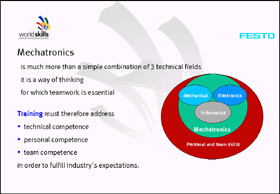
What is Mechatronics? When we use the word mechatronics at the WorldSkills Competition we mean industrial mechatronics. This is not only a combination of the mechanical, electronic and informatics aspects of automation, it also embodies the personal and team skills that industry needs to reach world class standards of excellence. The mechatronics competition reflects the way people work on the shop-floor – under pressure to design and implement solutions, maintain and constantly improve production – and to get machines fixed quickly when faults occur. And why a team of two? While industry requires that each individual master the different facets of mechatronics, it also recognises that each person has their strengths and weaknesses – and that only people working in a team, constantly learning from each other can master the challenges of Manufacturing Excellence. The competition demonstrates how these essential personal skills and qualities demanded by teamwork can be improved. |
|||||
|
||||||
|
||||||
|
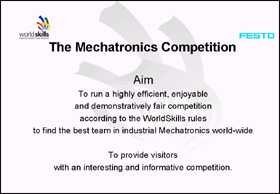
About the competition The aim of the competition is shown on the slide (see left - click to enlarge). Click here to read about the idea and concept of the WorldSkills Competition and the IVTO (International Vocational Training Organisation) Click here for the Trade description for Seoul 2001 Trade 4 Mechatronics. (File is a PDF file: 29KB - 3 pages) Stay tuned to www.worldskillsmechatronics.com. This website will continuously be updated up to and including the next competition in St Gallen. It will also include all National competition information. It is your 'one-stop' site for WorldSkills Mechatronics. |
|||||
|
||||||
|
||||||
|
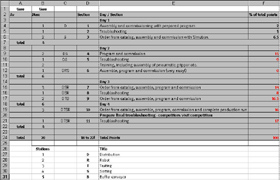
Seoul 2001 - structure of competition The competition lasts 4 days, and must cover between 18 and 22 hours work. The Mechatronics competition in Seoul was split in to 11 sections (see slide on left - click to enlarge). According to the Trade Description, points must be awarded as follows:
These points are distributed among the 11 sections. These vary in length from 30 minutes to 4 hours. Section 1 was the assembly of a known station - one that the competitors were familiar with. This was followed by troubleshooting on that station. In all subsequent sections, competitors either had to develop their own solutions to a problem by ordering parts from a competition catalogue (this was done in 2 sections) or build and integrate new stations of a given design. This experiment was part of the move towards adding Productivity to the criteria Time and Performance and is now anchored in the Trade Description, the document that outlines the scope of the next competition. The final, unofficial Section 12 was "Drinking Beer and "Singing in 3-part Canon". It was not evaluated. The unofficial section always seems to be the most fun for everyone... |
|||||
|
||||||
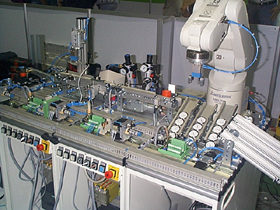 |
After 4 stressful days the competitors had all built an assembly line that manufactures a number of variants of products that have 3 different coloured housings and 3 instruments - clock, hydrometer and thermometer. The slides at the front of the robot station contain the instruments, the slides on the right are for the finished product by instrument type. The products were designed to be highly attractive as giveaways. They were! | |||||
|
||||||
|
||||||