
Call For Presentations WorldSkills Africa Swakopmund 2022 TVET Conference
Background
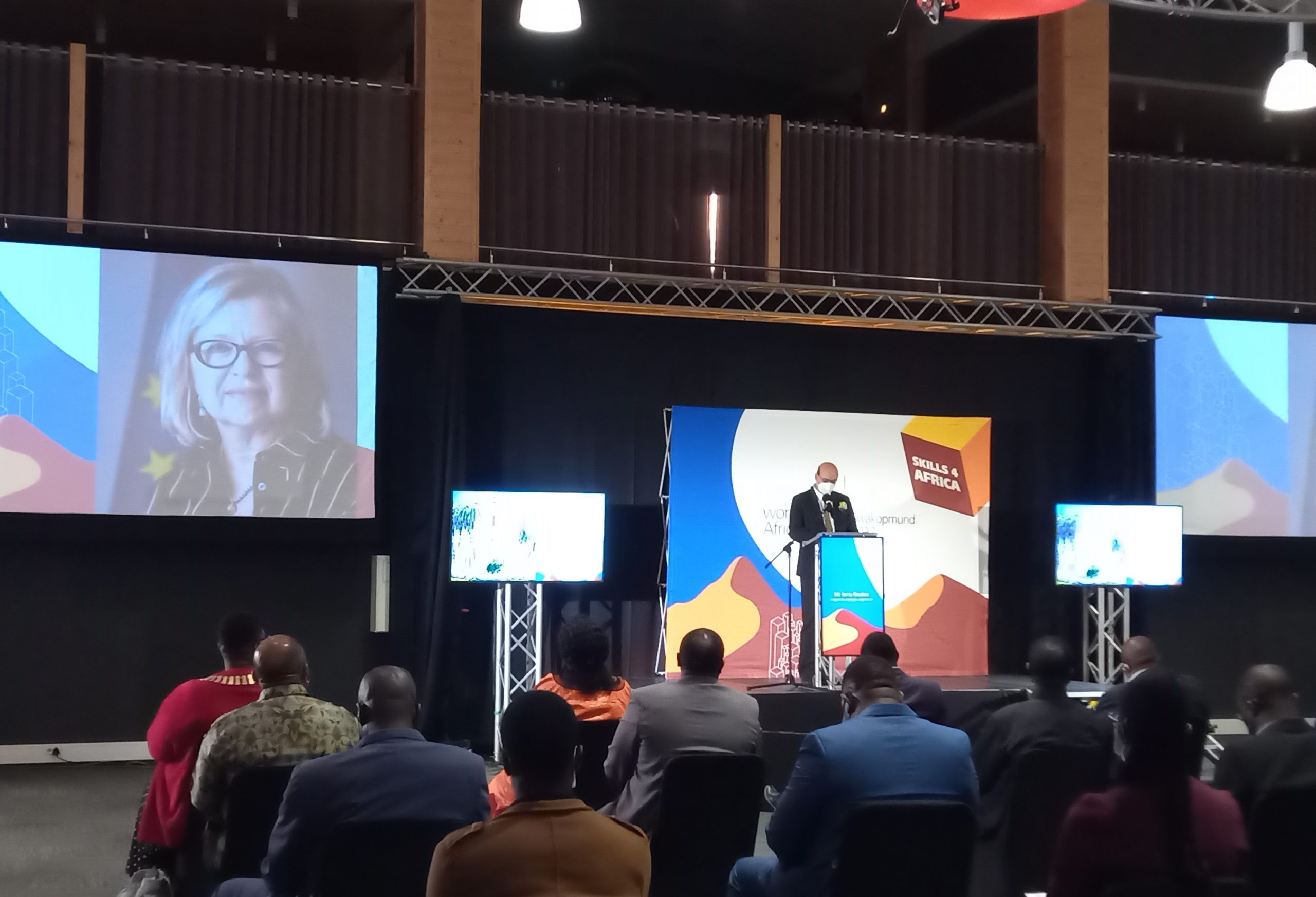
WorldSkills Africa Swakopmund 2022 (WSAS2022) is a three-tier event hosted by WorldSkills Namibia in partnership with WorldSkills International and the African Union. It includes a Skills Competition, a Careers Exhibition, and a TVET Conference.
The TVET Conference is to take place at “The Dome” in Swakopmund, under the theme: “Promoting Skills Development in the 21st Century for Sustainable Economic Growth and African Ownership”. It offers an excellent engagement platform for policymakers, industry, and TVET experts. Local, regional and international TVET experts are to engage conferencegoers by means of topical presentations as per the themes hereunder. The overarching purpose of presentations is to generate knowledge, share experiences, benchmark , and innovate.
The TVET Conference is supported by the African Union Commission (AUC), the African Union Development Agency (AUDA-NEPAD), and the German International Cooperation (GIZ) through the Skills Initiative for Africa (SIFA) programme, which is a programme of the AUC and AUDA-NEPAD with the European Union (EU) and Government of Germany, and the Association for the Development of Education in Africa (ADEA) as Conference Partners to curate the themes, content, and co-create the strategies for speaker engagement and the promotion of the TVET Conference.
Themes
The TVET Conference has capacity building, peer review, and enhanced cooperation as its main and overarching objectives. It is to include a range of topical discussions under four broad thematic areas as listed below:
| THEME 1: EFFECTIVE TVET SYSTEMS | |
|---|---|
| Background | TVET is a form of education and training which provides knowledge and skills for employment. TVET programmes are relevant to the needs of the labour market and for increasing the employability prospects of its graduates. It has a social and economic purpose i.e. enabling the smooth transition of trainees from the world of education to the world of work and supplying the labour market with competent graduates. Thus, TVET is positioned as an enabler for socio-economic growth. Evidence presented from both developed and developing countries, confirms TVET as a more effective form of education since it solves several developmental challenges, e.g. its ability to assimilate marginalised groups into its programmes. An effecive TVET system is one that fulfils its purpose. TVET systems in most African countries have been found wanting, in many areas. Challenges facing many African TVET systems mainly, include: skills mismatches, weak industry and stakeholder participation and incompetent TVET teachers. |
| Discussion points |
|
| THEME 2: TVET FUNDING MODELS | |
| Background | Despite interests in TVET programmatic expansion by many governments, particularly African countries, during the current decade – owing to its role in national development – TVET remains largely underfinanced. This is because it is regarded as an expensive form of education compared to general education (given high costs of material, equipment, facilities), and also the low share of public budget dedicated to TVET compared to other levels of training. Since a lack of funding has been one of the challenges affecting the TVET sector, in most African countries, some have introduced training levy systems, where certain industries that meet the legal requirements contribute a certain percentage of payroll in the form of a skills levy. |
| Discussion points |
|
| THEME 3: TECHNOLOGY AND TVET | |
| Background | There exists a symbiotic relationship between technology and TVET. Technological and societal developments, climate change, environmental degradation and scarcity of resources are the order of the day. Literature pro of TVET Technology claim that TVET is a key player in addressing these developments through the transfer of knowledge and skills. Additionally, in recent years there has been an increased focus on the use of Information Communication Technologies (ICTs) for the management and delivery of TVET. ICT is now considered by many governments as a critical component of a responsive, demand-driven TVET system tasked with meeting the needs of trainees/students for more flexible individualized training. International organizations such as UNESCO and ILO had already made commitments to the use of ICT to deliver TVET in both formal and non-formal settings. The COVID-19 pandemic experience gave the TVET sector no option, but to embrace technology in the delivery and management of TVET programmes |
| Discussion points |
|
| THEME 4: GENDER AND SOCIAL INCLUSION IN TVET | |
| Background | UN Sustainable Development Goal 4 on Education calls on all Member States to “ensure inclusive and quality education for all and promote lifelong learning”. The goal emphasized on “an equal access for all women and men to affordable and quality technical, vocational and tertiary education, including university”. In most African countries, certain groups of people have been excluded from participating in TVET. TVET has been a male dominated form of education. Additionally, people living with disabilities have also been denied an opportunity to enrol for TVET programmes. |
| Discussion points |
|
Invitation
We invite local, regional, and international TVET experts to be part of this Conference by means of topical presentations as per the themes and topics above. The overarching purpose of presentations is to generate knowledge, share experiences, benchmark, and innovate. Presenters will not be paid honoraria. However, the organizers will take care of the subsistence and travelling expenses. Prospective presenters should respond to this invitation as per the guidelines set out below.
Guidelines
- Applications will be considered against preset criteria, including thematic relevance, conceptual foundation,
documented theory, formatting, research, and experience. - Applications should not exceed 5 (five) A4 pages in font type: Arial, font size 12, and 1.5-line spacing, and
must include the following:- The presenter applicant’s qualifications, experiences, and expertise (CV)
- A summary of discussion points as per the conference theme selected
- Presentations must be formatted in terms of the following structure:
- Presentation Summary
- Introduction
- Body
- Conclusion
- Reference List (any referencing style)
Submission
The deadline for submission is 31 January 2022. For submitting applications or other questions, please contact the organizing team at conference@wsas2022.com.na.




2 Comments
Good day , in the event that you still want to entre is it possible .Plumbing
Good day, each country has submitted their entries. Lookout in the local media for the next national level competitions which will begin early next year